Dialogue Knights 26
Raja Hamid Rashid / Baghdad
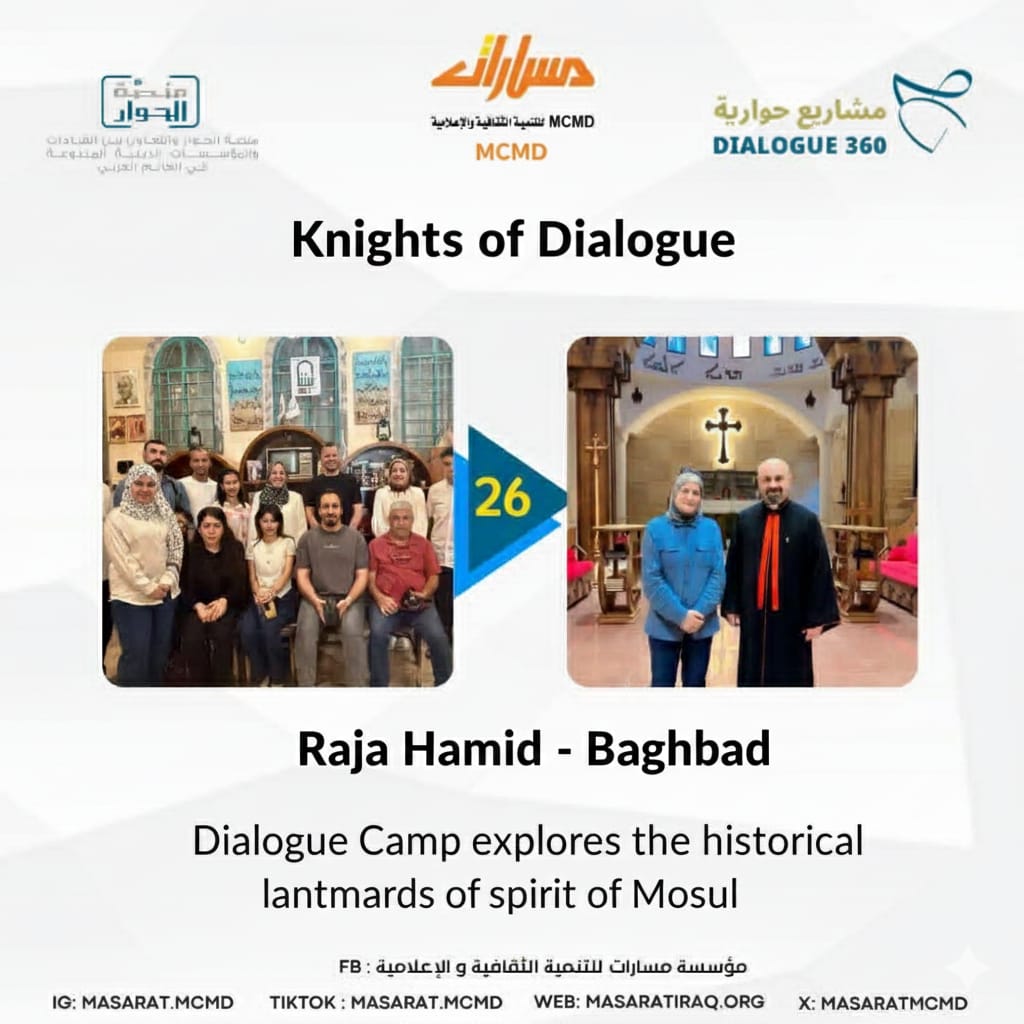
In the heart of Old Mosul, where the scent of history and hope rises from among the ruins, our tour took place as part of the Dialogue Camp program, held under the slogan “Through Dialogue, We Remain and Rise,” organized by Masarat Foundation for Cultural and Media Development in cooperation with KAICIID and Bayt Al-Ta’ayush. The tour included symbolic sites in the city, such as several churches, Al-Hadba Minaret, and Al-Nuri Mosque, in addition to visits to cultural institutions that emerged from the depths of suffering to restore the city’s identity that terrorism attempted to erase.
Al-Hadba Minaret… A Symbol of Pride and Resilience
During our visit to the historic Al-Hadba Minaret, I stood in awe of the greatness of its architecture and design. The minaret, whose name has long been associated with Mosul, still stands tall despite the destruction it suffered after being blown up by ISIS in 2014, before being rehabilitated following the liberation of the city.
We were received by Father Raed Adel, who provided a detailed explanation of the churches of Hosh Al-Bi‘a, their ancient history, and the ongoing reconstruction works that take into account their archaeological character and deep religious and human significance.
Father Raed also spoke about the interconnected social fabric of Mosul, recalling the story of Aboud Al-Tanbourji, the Christian builder who restored the minaret during one of its earlier reconstruction phases and refused to accept payment, saying, “This is God’s house; no wage can be taken for its construction.” This stands as clear evidence of peaceful coexistence among Iraq’s diverse components in the city. He also pointed to the prominent presence of influential Christian figures in Mosul’s economic and social life, such as Behnam Tarraz, Khudr Dahri, and Abu Al-Yasi, who contributed to supporting the city and its religious and social institutions through generous initiatives that embodied deep belonging to the place.
The camp participants’ tour also included visits to Al-Tahira Church and Deir Al-Sa‘a (The Clock Monastery), where we witnessed the effects of restoration and the return of spiritual life through prayers and masses, after years of devastation caused by ISIS.
Baytuna Foundation for Peaceful Coexistence
In Al-Farouq neighborhood, near Al-Nuri Mosque and Al-Hadba Minaret, stands an old Mosuli house that was turned into the headquarters of the “Baytuna for Culture, Arts, and Heritage” Foundation, established by Saqr Ma‘an Al-Zakريا just days after the city’s liberation on July 10, 2017.
We were welcomed by the foundation’s president, Saqr Al-Zakريا, who spoke about the idea behind its establishment, which stemmed from a sense of responsibility toward the devastated city. He emphasized that their primary goal is to protect Mosul’s cultural identity from being lost after the systematic destruction it suffered, which affected everything, even the collective memory of its residents. He noted that Mosul’s identity was damaged just as its infrastructure was, and therefore they work to preserve and restore it.
The foundation organizes cultural workshops, seminars, and artistic evenings, in addition to festivals and book-signing events. Among its priorities is caring for the new generation that was born during ISIS’s control of the city and grew up in an environment deprived of connection with Mosul’s history and identity, making it vital to reconnect this generation with its heritage to ensure the continuity of the city’s authentic culture.
After that, the camp participants visited the Mosuli Heritage Museum in the Hammam Al-Manqusha neighborhood, established in 2022. The museum is an old Mosuli house that contains tools once used in the past, such as the famous Singer sewing machine, charcoal irons, old telephones, and traditional household items including spoons, ladles, utensils, teapots, samovars, and furniture displays. An old map of Iraq adorns one of the museum’s walls, along with Iraqi currencies used across different historical periods, as well as photographs documenting the neighborhood at the end of the liberation battles against ISIS in 2018. The phrase “To Make a Difference” appears in both Arabic and English as a symbol of loyalty and pride in the sacrifices of the heroes who gave their lives for the liberation of Mosul.
Another panel features a photo of the martyr of Al-Hadba Minaret, the brave soldier Ammar Huraija, with his helmet displayed in front of it as a historical document commemorating the heroism and courage of Iraqis in defending their homeland. He was one of the most prominent and courageous fighters of the Counter-Terrorism Service and was the last soldier martyred in the battles to liberate Mosul, specifically in the Al-Kubaigh area near Al-Hadba Minaret. Ammar’s story is one of the most inspiring tales of resilience: he was besieged for five months at the Baiji refinery with a number of his comrades, and his family believed he had been martyred, yet he endured despite the hardships and returned to his family after the refinery was liberated.
One of the museum’s rooms was also dedicated to displaying traditional clothing of Iraq’s various components, including Mosuli, Kurdish, Yazidi, Sabean-Mandaean, Armenian, and Baghdadi attire.
Mosul will remain alive, with its towering minarets, mosque domes, church bells, and cultural institutions, forever pulsing with life.