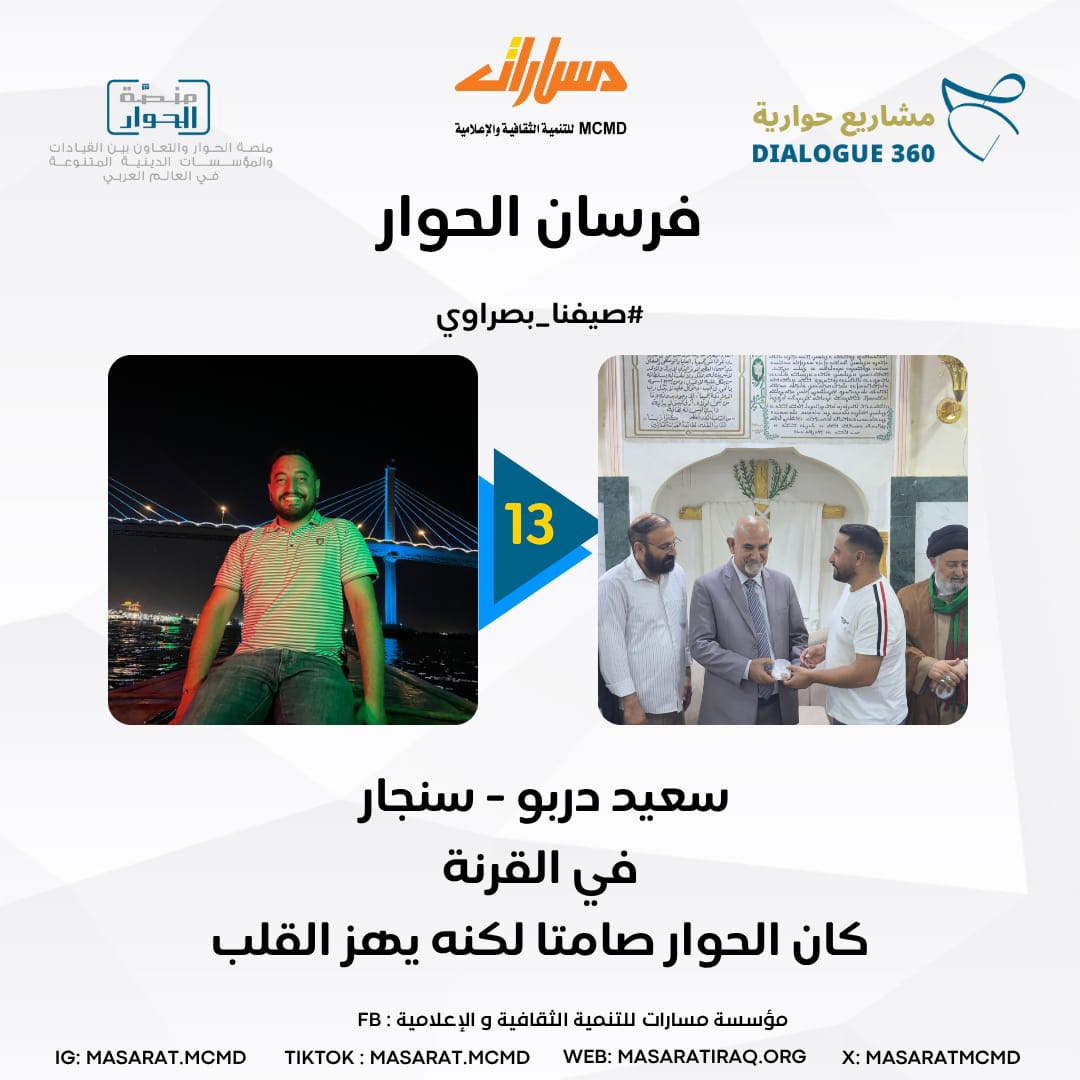
Saeed Darbo / Sinjar
We had heard about Basra, and we used to say:
“These are the people of generosity, the people of palms and water, who present the world with the most beautiful image of Iraq.”
But in a moment of honesty, I asked myself:
Is this really true? Or are these compliments, media, words that are said but not felt?
I had never visited Basra before, which is why I was among the first to support the idea of holding the “Education for Dialogue” camp there.
Even with the summer heat, I did not hesitate, nor did I retreat.
I was very happy that the first train I ever rode in my life was headed to Basra, the radiant city.
I am from Mount Sinjar, in the far northwest of Iraq,
and this journey carried me to the far southeast of Iraq — to Basra, to the sea, to Al-Faw.
From the mountain to the sea, from edge to edge.
But it was not just a distance, it was a journey into the depth of one homeland.
Upon our arrival, a Basrawi man dressed in traditional Arab attire welcomed us: a white dishdasha, a shemagh, and an agal.
I thought to myself: “They resemble the Gulf people!!”
I did not know that the origin of this attire is actually Basra, and that the Gulf adopted it from there, not the other way around.
I expected the man to take us to a hotel or an apartment because of the high temperature.
But I was surprised… when he opened the door of his home and said:
“You are our guests, and our family.”
Words cannot describe the feeling of seeing an entire family welcome you with such love.
I felt that I was not a stranger; I felt like I was in Sinjar at my relatives’ home.
I knew that there are people with dark skin in Basra, but I did not know about their deep African roots,
nor about their long-standing history and culture predating Islam.
We sat with them, laughed, sang, talked, and listened.
Every conversation enriched the soul, and every smile opened a window in the heart. Their hearts were white and beautiful, like their smiles on their dark faces.
They organized a folkloric musical evening for us in the Zubair farms — an unforgettable night,
full of the flavor of the south, the sound of the sea, and the warmth of memory.
We got to know people and places we had not even known from geography books.
We met Mandaean Sabians, Christians, Muslims, and dark-skinned people, all with pure hearts — hearts united by a homeland called Iraq.
We saw Iraq as it should be: diverse, alive, tolerant, and united in love.
Among the beautiful stops was our visit to the house of the poet Badr Shakir Al-Sayyab.
I stood where he wrote:
The sun is more beautiful in my country than elsewhere, and even the darkness
There, even the darkness is beautiful, for it embraces Iraq.
I felt that the poem had not vanished, and that Al-Sayyab still dwells in the river and among the people.
One dawn, we went to Al-Faw,
saw the Al-Faw Peninsula, the fish market, the fishermen at work, and the simple, sincere life of the people.
We stood at the confluence of the Tigris and Euphrates in Al-Qurna.
The meeting was silent, yet it shook the heart.
I would tell people: “I am from Sinjar,”
and everyone who heard it would smile and say:
“You are at home.”
Even the Basrawi elders, when asked about Sinjar, would reply:
“I served in the military there.”
Or:
“I had Yazidis from Sinjar with me at the front.”
Sinjar is known for its figs and tobacco… and Basra is known for its palms and dates.
From the fruits of the north to the fruits of the south,
from the dry smell of tobacco to the moisture of ripe dates,
I felt that Iraq is one tree, its roots in Sinjar and its fruits in Basra.
The flavor may differ, but the goodness is the same,
and the fruits differ, but the land is our mother for all.
In the wrinkles of the elders’ faces, you see Iraq — tired yet great.
You see the memory of a homeland that never dies, even if it suffers.
There, in Basra, I did not visit a city; I visited a purer version of Iraq.
An Iraq that does not ask you: “Which sect or religion are you?”
But asks:
“Tea with sugar or without?”
And there, when someone adds sugar to the tea glass, they do not say “I sweetened it,”
but simply say:
“I added sugar” —
as if they are thanking the moment, thanking you as a human, and thanking life for the blessing of meeting.
From Mount Sinjar to the sea of Al-Faw, I realized that what unites us is greater than what divides us.
In Basra, I saw the Iraq we dream of, and I will continue to seek it everywhere.