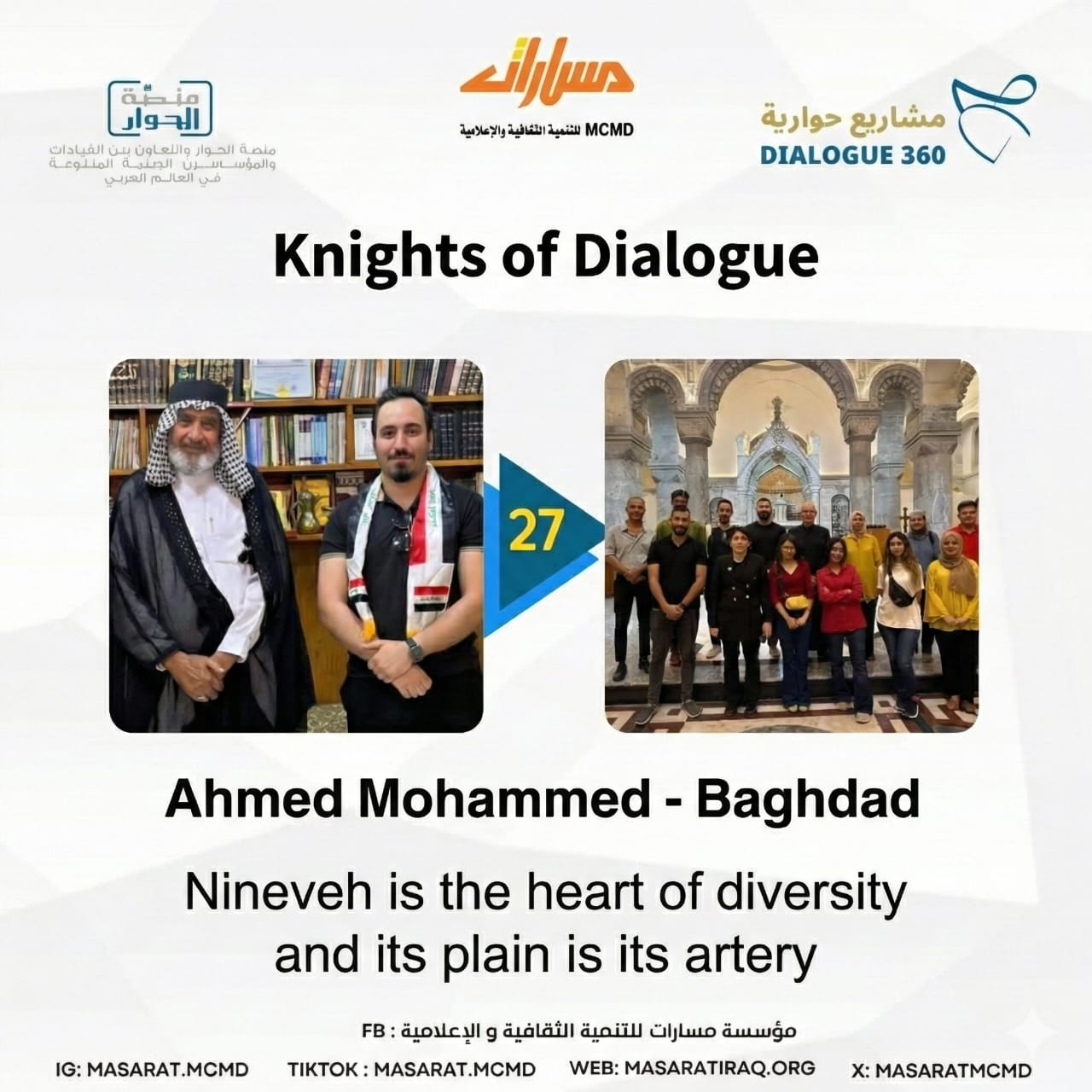
Ahmed Mohammed / Baghdad
Knights of Dialogue / 27
It was an unforgettable journey, in a city that embraces on its land a rich history and a unique cultural and human diversity…..
I began my tour by delving into its social fabric through a visit to the Nineveh Plain, specifically among the Shabak, this authentic component that enriches the region.
Between the Shabak and generous hospitality
Visiting the Shabak was a warm human experience. I was received with great generosity in their guesthouses, where I had the opportunity to learn about their customs and traditions. I spoke with their elders, foremost among them Mr. Mohammed Ali Har, who enriched me with insights into the history of the Shabak and their status in the Nineveh Plain. The visit was not limited to conversation, but extended to the dining table, where I tasted distinctive traditional dishes that reflect both the simplicity and richness of life, including foods that rely heavily on local agricultural products…..
It was not merely breakfast at the home of the distinguished Shabak media figure Imad Qusay, but rather an opportunity to closely observe the Shabak families’ strong attachment to their inherited heritage and traditions, especially in cuisine, clothing, and language.
As for the tour between the Monastery of Saint Barbara, the Church of Mar Addai in Karamlesh, and the Great Church of Al-Tahira in Baghdeda, Father George Jahola immersed us in stories and narratives inspired by the deep coexistence among the city’s components.
These encounters left a profound impact on me regarding coexistence and harmony, which are deeply connected to a sense of citizenship and humanity, away from religion, sect, denomination, color, or language.
Father Eddie also held a prayer with us for peace in Iraq and the world, in a spiritual atmosphere that enveloped us with an indescribable feeling.
In Mosul “Al-Hadba,” which is slowly recovering….. the main objective was visiting the Al-Hadba Minaret, that landmark which represents the soul and history of the city. It has stood again in a great symbolic challenge to the ravens of evil who destroyed it, returning with its distinctive symbolic lean to greet its visitors and whisper to them tales of centuries past.
Seeing the reconstruction efforts around it and throughout the old city as a whole inspires hope that this ancient city will regain its glory and vitality as a cultural and economic center in Iraq.
This feeling did not come from nowhere, but from clear messages carried in the tones of the voices of those we met from different religions and sects.
I returned from this journey with the voice of Father Raed Adel resonating in my ears, the icon of Mosul who has stood and continues to stand as a symbol of coexistence and dialogue among the city’s components, and the activist Saqr Al-Zakaria, the diligent young man who lovingly and carefully preserves the city’s heritage and presents it to its visitors, saying: this is our beloved Mosul.
In short, whoever has not visited Nineveh Governorate and explored its present and its history, which forms a blend of cultural diversity in all its forms, has missed much in life.