Noha Sudair / Baghdad
Knights of Dialogue – 31
Peaceful coexistence among Iraq’s components is one of the pillars of stability and development. It is not merely a social reality, but a human and civilizational value that preserves and enriches a unifying national identity. The Nineveh Plain represents a living model of this diversity, where multiple religions, sects, and cultures come together, forming a mosaic that reflects Iraq’s richness and its deep-rooted history.
A richness that cannot be fully understood without a field visit to the Nineveh Plain…
From here, we set out with Masarat Foundation for Cultural and Media Development on a visit during which we met a number of religious, social, and cultural figures, and explored lived experiences that express the spirit of coexistence and diversity.
The first of these meetings was with Sayyid Mohammed Ali Har Al-Aaraji, a Shabak religious leader and notable of the village of Manarat Shabak, where the discussion focused on the role of religious leaders in promoting a culture of social peace and the importance of strengthening dialogue among components.
Then we met Sayyid Abdul Zahra Al-Agha, a researcher in Shabak affairs, who provided an overview of the history of the Shabak and their contributions to the fabric of Iraqi society, emphasizing the challenges and ways to preserve the cultural identity of the component.
After that, we met with Sayyid Muadh Haji Abbas, a member of the Nineveh Provincial Council, where the discussion revolved around the importance of supporting civil society initiatives and activating the role of official institutions in serving the people of the region and consolidating stability.
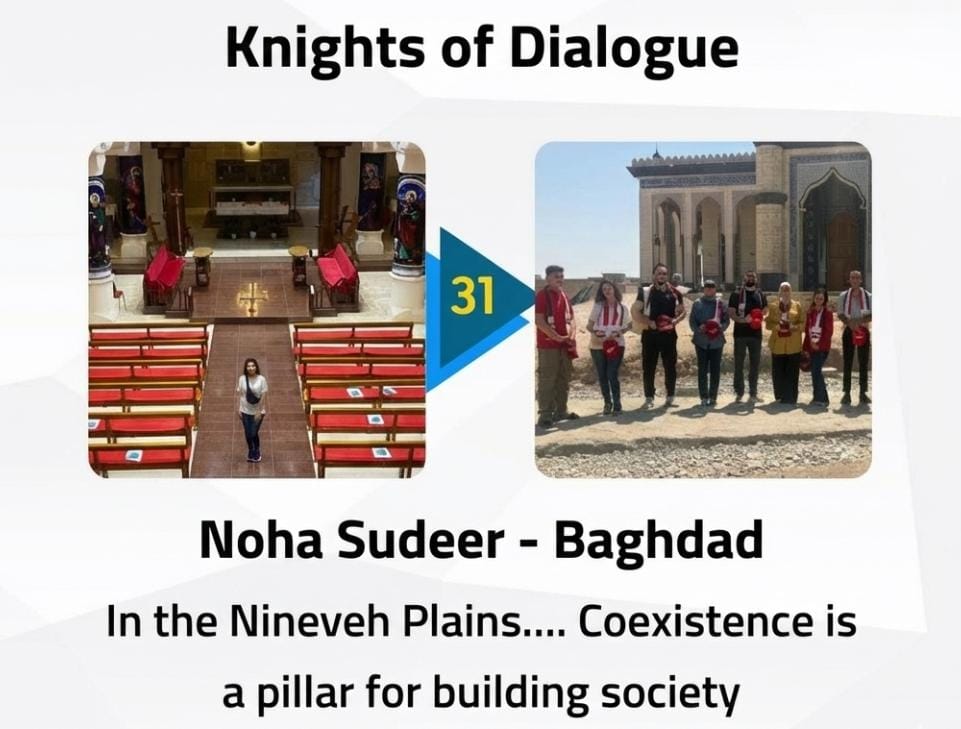
We then continued the tour to the Mosque of Zayn Al-Abidin bin Ali, one of the most prominent landmarks of the Plain and an important religious and social center for the Shabak community, a landmark that highlights the continuity of religious life in the region.
To learn about the media landscape in the city, we held an open discussion session at Ain Al-Aqalliyat Radio, which serves as a media platform expressing the issues of religious and ethnic components and broadcasting messages of coexistence and peace, thereby enhancing societal awareness of the value of diversity.
On the other side, representing the rest of the components of the Nineveh Plain, there was the spiritual journey to the Church of Saint Barbara and the meeting with Father Adi at the Church of Mar Addai the Apostle, through which we learned about the role of the Church in preserving the historic Christian presence in the Nineveh Plain and promoting the values of love and tolerance.
This was followed by a visit to Al-Tahira Church in Al-Hamdaniya and a meeting with Father George Jahoula, who emphasized the importance of unity among the people of Nineveh in all their diversity and the necessity of solidarity in facing current challenges.
Amid these awe-inspiring spiritual atmospheres, the day ended and the team began an evening family-style activity that I will never forget…
The team was hosted with great generosity by the family of Sayyid Imad Qusi, the Shabak media and civil activist.
The Knights of Dialogue team spent its first night in the Nineveh Plain to the sounds of memories shared by the women, men, and youth of the city in a guesthouse filled with stories of a bygone time and hopes for the time to come.
Stories which, if brought to light, might gain a level of prominence rivaling the tales of One Thousand and One Nights…
The traditional food dishes, which themselves tell the story of an ethnic component rich in diversity and deep-rooted in history, were distinctive, such as various types of Kubba Do and dolma, in a family atmosphere that embodied the spirit of authentic Iraqi hospitality and highlighted the value of folk heritage in strengthening human relationships.
This tour showed me that diversity and plurality in Iraq are not a challenge, but a treasure among the country’s greatest assets, and that getting to know the cultures, religions, and sects of the people of the nation opens broader horizons for understanding and peaceful coexistence. From here, Masarat Foundation continues its work in building bridges of dialogue, based on a firm conviction that coexistence is the most effective path toward building a prosperous and secure society for all Iraqis.