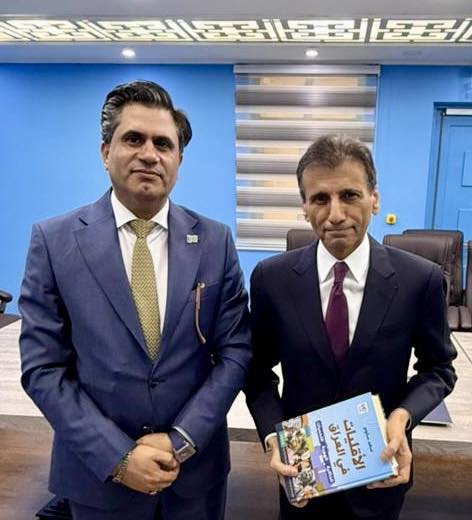
His Royal Highness Prince Hassan bin Talal sent a message to Dr. Saad Saloom, the General Coordinator of Masarat, after reviewing the book Christians in Iraq: Comprehensive History and Current Challenges, published by Masarat.
In the introduction to his message, Prince Hassan emphasized the importance of this encyclopedia, describing it as a “protective compendium,” and praised the combination of solid historical research with contemporary perspectives and forward-looking insights in the book. He expressed particular admiration for the sections authored by Saloom, especially the introduction: “Can the Middle East Be Imagined Without Christians?”, Chapter Thirteen: “Towards Strengthening the Christian Presence in Iraq and the Middle East,” and the concluding remarks titled “Signs of a Middle East Without Christians.” His Royal Highness also commended the compilation of legislation, statistics, and documents concerning Iraqi Christians included as appendices in the book.
Prince Hassan highlighted the points of convergence between the book Christians in Iraq and the broader work of Masarat, and his own initiatives, which include the establishment of the Royal Institute for Religious Studies and the Arab Thought Forum, aimed at promoting deep dialogues among followers of diverse cultures, religions, and sects for the benefit of humanity as a whole. He stressed the importance of effective networking between these institutions to protect diversity, promote meaningful dialogue, strengthen citizenship, and safeguard pluralism in the region.
It is worth noting that Christians in Iraq is a comprehensive historical encyclopedia documenting the Christian presence in Iraq from the introduction of Christianity in the first century CE up to the ISIS invasion of Nineveh Governorate. The book, spanning over 800 pages, was published in 2014 as part of Masarat’s “Pluralism in Iraq” series. It included contributions from prominent Iraqi Christian historians, archaeologists, and intellectuals, such as the late Father Boutros Haddad, Cardinal Louis Sako, historian Suha Rassam, the late archaeologist Abdul Amir Al-Hamdani, archaeologist Hikmat Al-Aswad, among others.