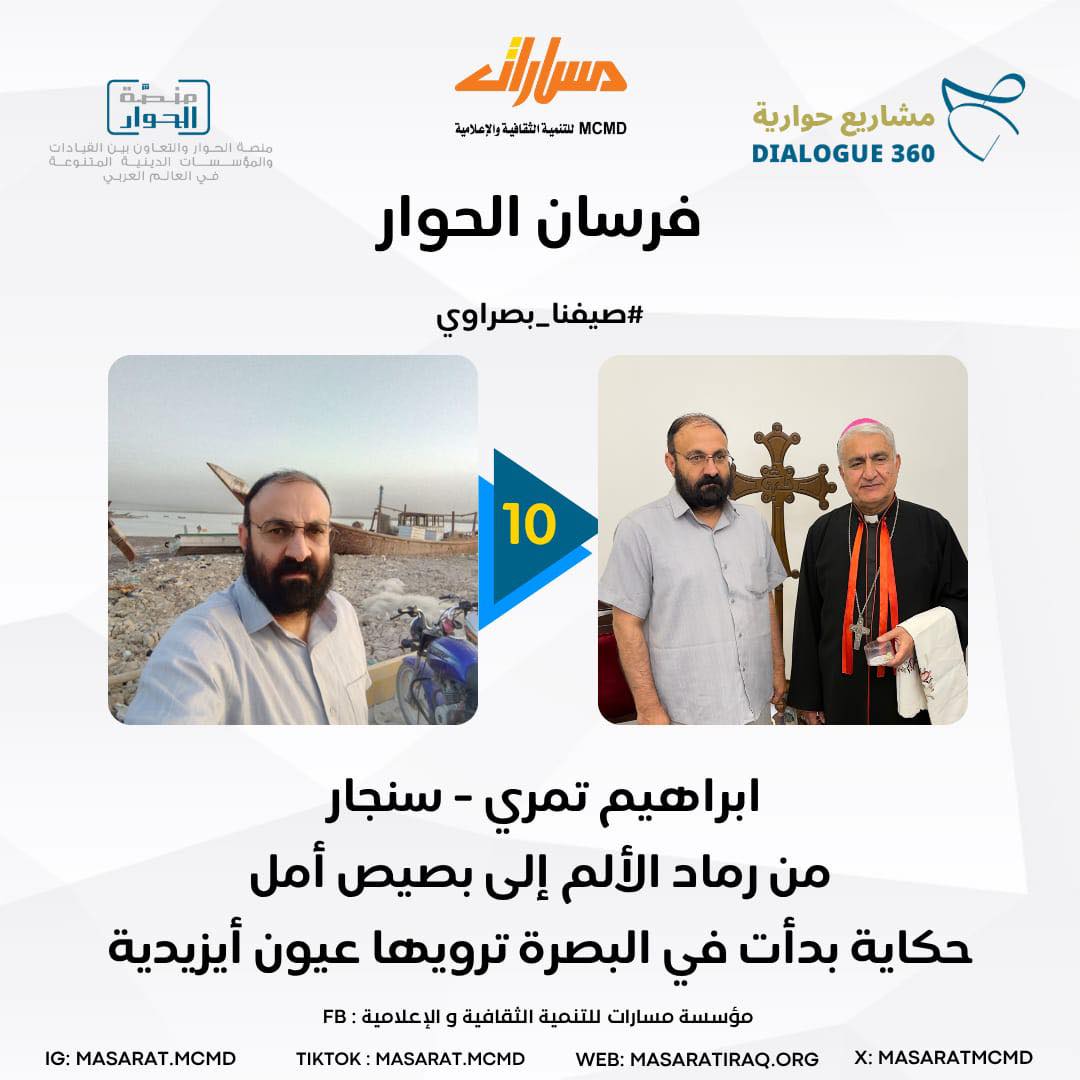
Knights of Dialogue / 10
Ibrahim Tamri / Sinjar
At the beginning of the journey, we carried nothing but heavy suitcases accompanied by anxiety and worries, with hearts lost among the ruins of war and the aftermath of genocide. We are the children of Sinjar, children of the mountain and salt; we are those who have known pain more than we have known our homeland.
We thought pluralism was a distant dream, and that peace could not dwell in this place. But the journey that brought us together in this diverse setting, among remarkable people in the Citizenship and Dialogue Camp organized by Masarat Foundation for Cultural and Media Development, opened doors that had been closed within us and redefined “homeland” in our memories.
From the moment we boarded the Baghdad – Basra train, we began to move away from geographical pain and approach a new geography—the geography of humanity. We did not know that Basra, which we had never visited before, would embrace us with such warmth and hospitality. Nor did we know that in Al-Zubair, Al-Faw, Abu Al-Khaseeb, and Al-Qurna, we would see our weary reflection in the eyes of others from the diverse communities of Iraq.
We met Christians, Muslims, and Mandaeans, sat side by side with people of beautiful dark skin, and listened to stories from the south brimming with resilience and life. In every face we encountered, we saw a piece of a forgotten homeland we had dreamed of. A woman from Al-Zubair spoke of discrimination, a dark-skinned Muslim artist sang for peace in the church, and a Mandaean sheikh spoke of the river as a spiritual father to all. In every moment, we rebuilt the idea of Iraq—not just as a geographical homeland, but as a human homeland that accepts everyone and protects differences without frightening them.
Through these visits, we realized that religious and cultural pluralism is not a burden as portrayed to us during times of pain; rather, it is richness, strength, and a source of inspiration.
For the first time, we felt that we were not guests in this homeland, but its makers. We are Yazidis, Mandaeans, Christians, Shiites, and Sunnis… we all must draw one map, called Iraq.
We left this camp with warm hearts, filled with the belief that we can truly be partners in rebuilding this homeland that we lost in dark moments. It began to return to us in the smile of a Basra child, in the embrace of the elders of Abu Al-Khaseeb, in the voice of Al-Sayyab along the Shatt al-Arab, and at the Tree of Adam in Al-Qurna, where the two rivers meet, marking the start of civilization.
This experience was not just a field visit; it was an inner healing and a rebirth of the homeland within us. We learned that dialogue does not erase differences, but teaches them how to rise to humanity.
We returned from the south of the homeland carrying peace in our suitcases and Iraq—as it should be—in our hearts.