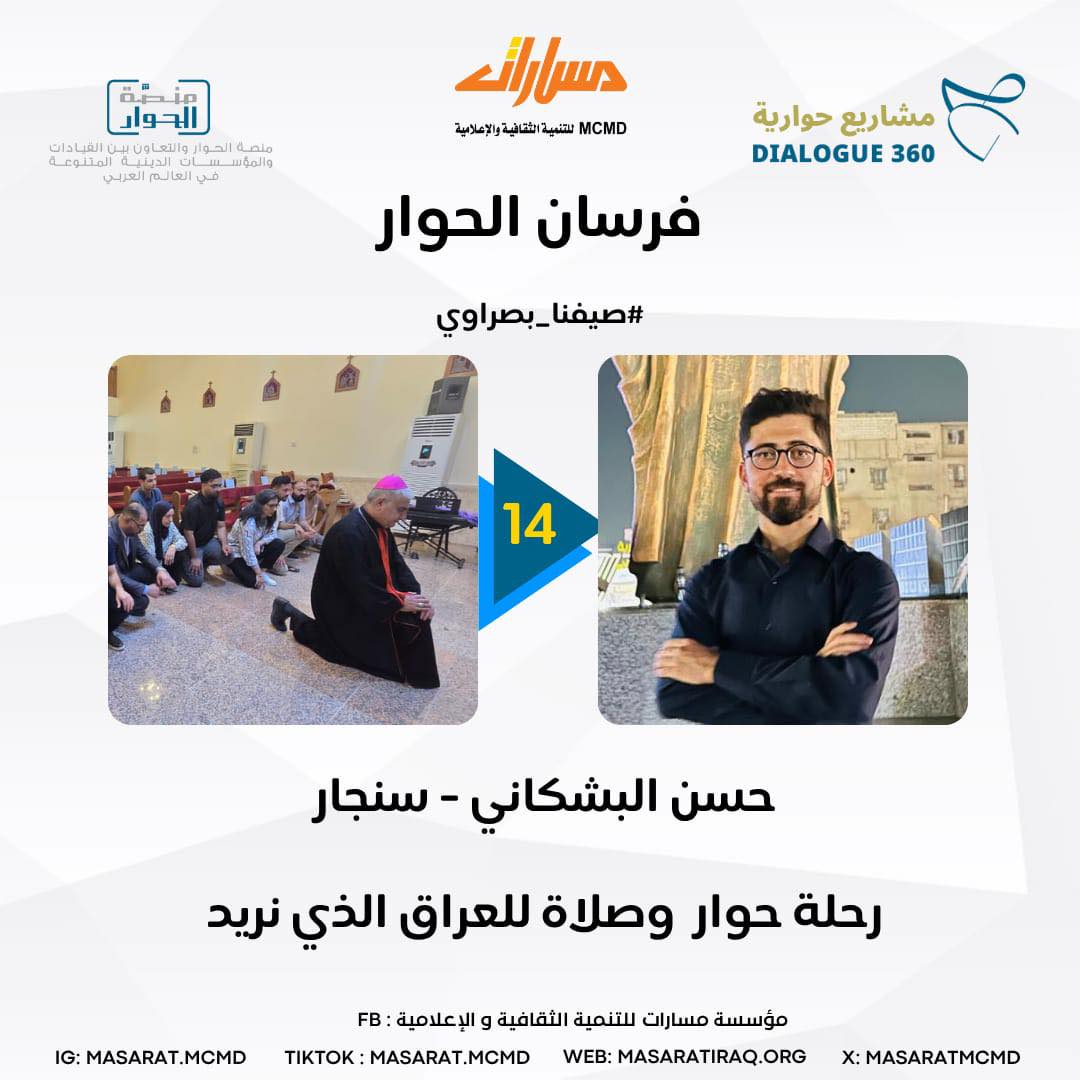
Knights of Dialogue / 14
Hassan Bashkani / Sinjar
After seven hours spent in the car on my journey from Sinjar to Baghdad, followed by ten hours on the train from Baghdad to Basra, images raced and crowded my mind during this long, arduous journey to a city I knew nothing about except for its scorching sun and what the media had reported two years ago about their hospitality for guests of the Gulf Cup football tournament.
When I finally arrived in Basra, the feeling was indescribable. The first impression, from the first smile of a young Basrawi I met, made me realize that I was not in an ordinary city.
With his dark complexion, white attire, and accent that penetrated deep into the heart without permission, he left nothing for me to read—my entire language disappeared in an instant in front of the warm reception he, a son of Zubair city, gave us.
Amid this whirlwind of emotions, a sense of pride in my Iraqi identity began to rise. As the car wheels rolled through a city whose streets still exuded heritage, cultural symbols, and ethnic diversity, I wished the train could connect all the cities of Iraq so that my family and friends could see, as I did, all this richness of diversity, heritage, and civilization in every city I visited.
We were welcomed by our Basra colleagues at a breakfast table, featuring something called…
Their bright, dark faces, mixed with wisdom and humor, and eyes that looked far, spoke to us about the rituals and customs they practice in their daily lives.
The smell of the sea alone was enough to make dialogue a strategic choice among all the communities. That is how I felt when I boarded a small boat on the Shatt al-Arab.
At night in Al-Faw, when the lights of the large Faw port gleamed, I told my colleagues under the stars that the future is born from the heart of Basra. Therefore, dialogue is our weapon if we want that future to be honorable and bright for us and for the generations to come.
To the sound of the waves before sunrise, as if we were in a stolen moment from Sinbad’s tales, the fishermen began to unload their catch—sea fish I had only seen in pictures before. These fruits of the sea were strange to me, a child of the mountains. The Basrawis did not just delight us with the scenery; lunch included six or seven types of fish at the home of a fisherman who had spent his life between the nets, the sea, and the shore of Al-Faw Peninsula.
In the conversations with the people of Basra, we did not hear discrimination based on color, religion, or sect. No one asked whether we were Yazidis, Muslims, or Christians. Basra united us in its church to pray together for Iraq. Its Mandaean and Sabaean children, its white and dark-skinned people—all together, a miniature, united Iraq. Then we stood in the presence of its great poet, Badr Shakir al-Sayyab, and engaged with its academics, artists, intellectuals, and religious leaders, and even with the tea seller on the corniche.
We stood among the ruins of poetry and words, exchanging ideas about love and peace, focusing on continuous dialogue to bring the Iraqi community closer together.
The days in Basra are unforgettable, unlike any other—blended with the generosity of its people and the warmth of their souls, which will remain in my memory, along with their fragrance, from the beginning of Basra to the last border point of Iraq.
Dialogue, gentlemen, must be as lofty as Basra’s palm trees, as sweet as its dates, and as warm as the morning tea served by a farmer in a fleeting moment in the orchards of Abu Al-Khasib.
The dialogue successfully spread across the city’s communities through an excellent societal structure called the Council of Tribes and Basra Communities, whose members we met. I wished for a similar structure in my wounded, resilient, and patient city of Sinjar—a gathering embracing the beautiful ethnic diversity, practicing dialogue to resolve any potential disputes among religious groups in Basra. A group of community leaders works together to protect diversity, accept others, and collaborate as one team for a society free from hate speech.
Today, I returned from Basra a different person from the one who came from Sinjar days ago. I became a Sinjari-Basrawi-Baghdadi, eager to share what I saw in Basra with the whole world. Yet words fail me… I now realize that dialogue is not merely conversation between two or more people. It is knowing the other, seeing them as they truly are, and coexisting with them so that each of us accepts the other as they are.
I am Hassan, son of Sinjar. I lived in the homes of Basra for a few days, and I fell in love with its sun, salt, and air.