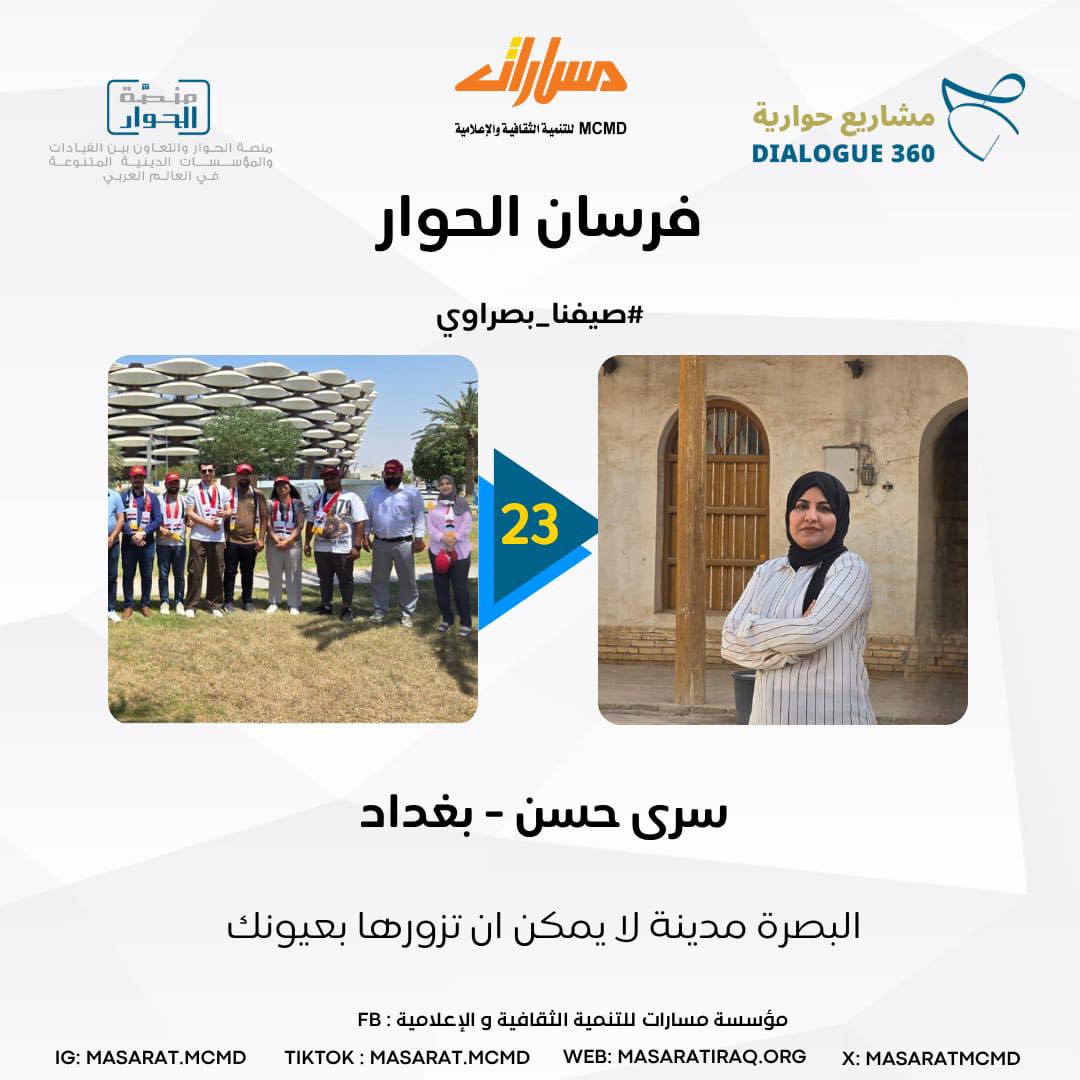
Knights of Dialogue / 23
Sura Hasan / Baghdad
Perhaps it takes a stroke of luck and great divine grace to find ourselves in a unique experience that, in a few days, feels like a lifetime… and that is exactly what happened to me. This is the story…
I have spent my life, over the past years, packing my bag from time to time to visit a country or a city. Travel has always been a hobby for me, an escape from life’s pressures, and above all, a requirement of my work. But this trip was fundamentally different…
It was a unique experience among cities within my own country, cities I had visited or passed through countless times. The names were not strange to me, nor their lands, nor even their people—I had friends and acquaintances there for years—but suddenly I discovered that these cities were completely new to me. How could it be, when I knew their streets, their markets, even the names of vendors in their shops, restaurants, and hotels?
The group traveling with me this time was a complete cross-section of Iraq, representing multiple religions and ethnicities. Differences in faith or ethnicity were no barrier; they became bridges for communication and cooperation. Together, we were one heart, eager to explore the world of archaeology and the expansiveness of the medieval centuries.
We exchanged ideas and concepts about dialogue and its importance among the components of society with an open spirit. The aim of these discussions was not to prove who was right, but to listen, understand, and appreciate differing perspectives. This was the “Through Dialogue We Remain and Rise” camp—an experience that taught me that difficult circumstances reveal the depth of humanity.
Participating with the Knights of Dialogue in this camp was a completely different experience from previous camps.
We began in my city, Baghdad. For many northern colleagues, it was their first visit. I expected to be their guide on this journey, or so I thought—but the surprise was my own feeling that I was seeing Baghdad I love for the first time.
There is a huge difference between living in a city for a lifetime and thinking you know its streets, only to suddenly realize that what you know barely scratches the surface of its history, beauty, and splendor. The most beautiful part was seeing my city through the eyes of others: the Tigris River and its waters flirting with a small boat carrying Iraq’s diversity across its banks, the al-Mutanabbi Statue and Al-Rasheed Street, the old government palace domes, the gilded shrine of Abi Hanifa, the alleys of Al-Adhamiya, Baghdad’s universities and homes, the smiles of its people, the academics and artists, its popular restaurants, and the faces of its residents whose wrinkles tell stories like a 21st-century Sindbad. Each of us in Baghdad now had a thousand and one marvelous stories, and each of us became a new Sindbad.
It was a journey to discover Baghdad through the eyes of Iraqis of different faiths.
On the slow train, we moved together to Al-Mu’allaq in Basra, then to Al-Zubair. The people of Al-Zubair have a unique world: a fresh culture, open society, and pure hearts, as if to say to the world, “We are your people, and you are the children of Iraq.” The music of dark-skinned communities carries you to a world of dreams and life, intertwined with the historical tales of Dr. Thawra Yousif—a lesson in history, anthropology, rituals, knowledge, and the future all at once.
My first visit to various regions of Iraq, like Al-Faw, felt like discovering a place that is not a city but a story. Walking on Al-Faw’s land, I was struck by the strange wonder of a place that preserves a natural beauty making the visitor reflect and feel they are at the heart of real Iraq. Its towering palm trees symbolize patience. We needed no tour guide; the people led us with their hearts before their hands. Here, a visitor understands that Al-Faw’s beauty is measured not only by nature but by its people, whose purity mirrors the land itself.
The situation in Al-Faw was much the same: familiar faces, beloved customs, joyful and generous spirits, hospitality. I could not comprehend why the organizers of the camp chose to make people’s homes the camp’s base. Normally, camps are in tents or sometimes hotels, as in Baghdad. But in Basra, our “tents” were the eyes of the locals and their hearts—our hotels. We stayed with them until morning, listening to melodies and their soulful voices, or the sound of domino tiles hitting the tables. One night, we made jewelry from gemstones with the daughters of a household, while they shared stories about henna cultivation.
Before dawn, we went to the maritime tongue, the Al-Nag’a, where fishermen display their catches. Between hammour and zbidi fish, sails, and the voices of sellers, the fragrance of Basra’s sea and its unyielding sunlight prevail. Such immense yet simple wealth, for people who live near sufficiency… remarkable.
From Al-Faw to Khor Abdullah, then Abi Al-Khasib, between waves and palm trunks, we raced to experience their hospitality. We had breakfast in the orchard of Mr. Muslim Abdul-Sayyid (Abu Saad) and lunch at Mr. Ismail Habib (Abu Muhammad), who condensed the essence of Basra cuisine. Mrs. Muhammad’s cooking—especially the fish—was a cultural experience in itself.
Jikor village was not new to me; I had struggled with its poet during secondary school—Badr Shakir Al-Sayyab. Today, I was visiting his home, one of the greatest modern Arab poets. I felt his spirit welcoming us, moving with us between rooms, from one picture to another. Walking through Al-Sayyab’s house with his cousin Mr. Faiq Al-Sayyab, I felt as if entering a timeless world; everything whispered his words, as if his poetry still lingered in the air. I emerged carrying a unique feeling I had never experienced before, shared even by my colleagues from Sinjar, Baghdad, and Basra—a “Sayyab Syndrome.”
A visit to Basra is incomplete without standing at the Shatt Al-Arab, the eternal dialogue between the eyes of passersby and the gentle waves caressing boats beneath the old Tanuma Bridge and the modern Italian Bridge, telling endless stories of a city unlike any other. The water’s surface in Shatt Al-Arab was a canvas only the south, southern Iraq, could paint—a south of the heart, alive and vibrant.
The scene completed at the Basra Channel: the media face of Basra, the dark complexion sunlit with warmth, welcoming visitors with smiles that left me speechless. Programs, news, and continuous coverage introduced us to Basra, and we left carrying its tourist guide in my hands as if holding all of Basra itself.
This guide was not our only gain. At the church, we met Bishop Habib Al-Noufali, who shared life lessons in philosophy and theology, the importance of protecting diversity, and understanding others. He filled our hands with wonderful publications, beginning with the Holy Bible, feeding our souls with the sanctity and purity of the place. Similarly, with the tribal council and Basra’s components at the Mandaean celebration, and at the Artists’ Syndicate, the spirit of Basra shone everywhere.
Theatre was the highlight, and the place’s magnificence defies words. Yet all of that day’s tour was one thing, and the last afternoon another: Al-Jadh’a Al-Nakhla Stadium! Pure madness! Midday heat in Basra, reaching 50°C in the shade, with the northern sons of the homeland—the mountain and snow children—on the field.
What a stadium! A masterpiece narrating Iraqi creativity from Ur, Babylon, and Al-Hadr to Al-Jadh’a Al-Nakhla. Basra’s colleagues had managed, with difficulty, to secure permission for the team to train there under media restrictions. And so, we were on the field, between the goalposts of Jalal Hasan, where all of Iraq sat, united in love and support for the country, regardless of religion, color, sect, or ethnicity. Here, nothing outweighs the love of Iraq.
We sat alone in the stadium, cheering with all our hearts for a united Iraq, forgetting the sun and heat, until the stadium director announced the visit’s end.
Yes, it ended—the visit to Basra, cradle of civilization, history, past, present, and future. A city of diversity, Iraq’s breadbasket, and economic hub.
Basra cannot be visited with the eyes alone; one must experience it with the soul, for it will remain in your spirit forever, like a faithful beloved.
Yes, it ended, but another visit awaits in Al-Qurna, where I will tell the story of the embrace of the Tigris and Euphrates and their journey, carrying the Dialogue of Peace from the far north to the south of the homeland soon.